 Tronlink
: How Token Types Affect TRON Transfers
Last updated ·TronLink is a self-custody wallet for TRON assets. Direct TRX and TRC-10 transfers use Bandwidth, while TRC-20 transfers also consume Energy; recipient activation can add costs.
- TRON Asset Coverage
- TRX, TRC-10, TRC-20, and TRC-721.
- Direct Transfer Resources
- Direct TRX and TRC-10 transfers consume Bandwidth without TVM execution. Transfers to unactivated recipients follow separate account-creation payment rules.
- Smart-Contract Resources
- Contract calls consume Bandwidth and Energy. A deployer can cover some Energy, subject to its configured share, the contract's limit, and its available staked or delegated Energy.
From Token Type to Transfer Result
-
Identify the Transfer Method
TRX and TRC-10 can move through direct native transactions. TRC-20 transfers invoke token contracts, so TVM computation adds an Energy requirement. TronLink also supports TRC-721 assets; operations that invoke their contracts follow the same resource rule.
A smart contract can also move TRX or TRC-10 internally during execution. Those movements belong to the surrounding contract call, which carries its own Energy requirement. The asset's ticker alone therefore cannot identify every resource requirement.
-
Check the Recipient's Activation State
A direct TRX or TRC-10 transfer to an unactivated address can activate the recipient, changing its account state. On Mainnet, this path charges a 1 TRX account-creation fee. The network scales its Bandwidth requirement by the account-creation multiplier, currently 1 on Mainnet. Only the sender's staked or delegated Bandwidth can cover that requirement; free Bandwidth does not qualify. If the allocation falls short, the network consumes none of it and adds a fixed 0.1 TRX charge. Governance can change these fees and the multiplier.
When a smart contract transfers TRX or TRC-10 to an unactivated recipient, the contract path activates that account. This path does not charge the direct activation fees of 1 TRX and 0.1 TRX. Account creation instead adds 25,000 to the relevant TVM call's base Energy cost. The initiating account still pays the outer transaction's Bandwidth through the standard order. The internal transfer carries no separate Bandwidth charge.
-
Determine Bandwidth and Energy Payment
Under the standard Bandwidth payment order, the network first tries the sender's staked or delegated allocation. If that cannot cover the entire transaction, the network tries free Bandwidth. Free payment requires both the account's remaining quota and the network's shared free quota to cover the whole transaction. If neither source qualifies, TRON burns TRX for the entire Bandwidth requirement. The network does not combine these quotas or charge only the uncovered difference.
TRC-10 issuer sponsorship can precede this standard order when a non-issuer transfers tokens to an activated recipient. The sender's remaining sponsorship allowance for that token must cover the whole transaction. The token's remaining shared sponsorship allowance and the issuer's available staked or delegated Bandwidth must each cover it too. Otherwise, the sender pays through the standard order. Transfers to unactivated recipients follow account-creation rules and do not qualify for issuer sponsorship.
Energy allows partial resource coverage before a TRX burn. Contract settings first determine the deployer's assigned share. Its actual contribution cannot exceed that share, the contract's
origin_energy_limit, or its available staked or delegated Energy. The caller covers the remainder with available staked or delegated Energy first, then by burning TRX.The transaction's
fee_limit, expressed in sun, caps the caller's total Energy budget, including available Energy and the TRX-funded portion. A deployer's contribution sits outside that caller-side budget. A subsidy therefore leaves the caller responsible for any Energy shortfall within the same limit, plus the transaction's Bandwidth. -
Read the Execution Result
During contract execution, TRON deducts Energy as the TVM runs instructions. A smart-contract call whose caller-side Energy use would exceed the budget implied by
fee_limitreverts withOUT_OF_ENERGY. The network still charges consumed Energy; that limit caps only the caller's portion.The transaction receipt provides the authoritative record of actual resource usage. Read the execution outcome alongside those charges: a fee can accompany a failed transfer.
Tronlink: How Token Types Affect TRON Transfers
- From Token Type to Transfer Result
- Transfer Decision Checklist
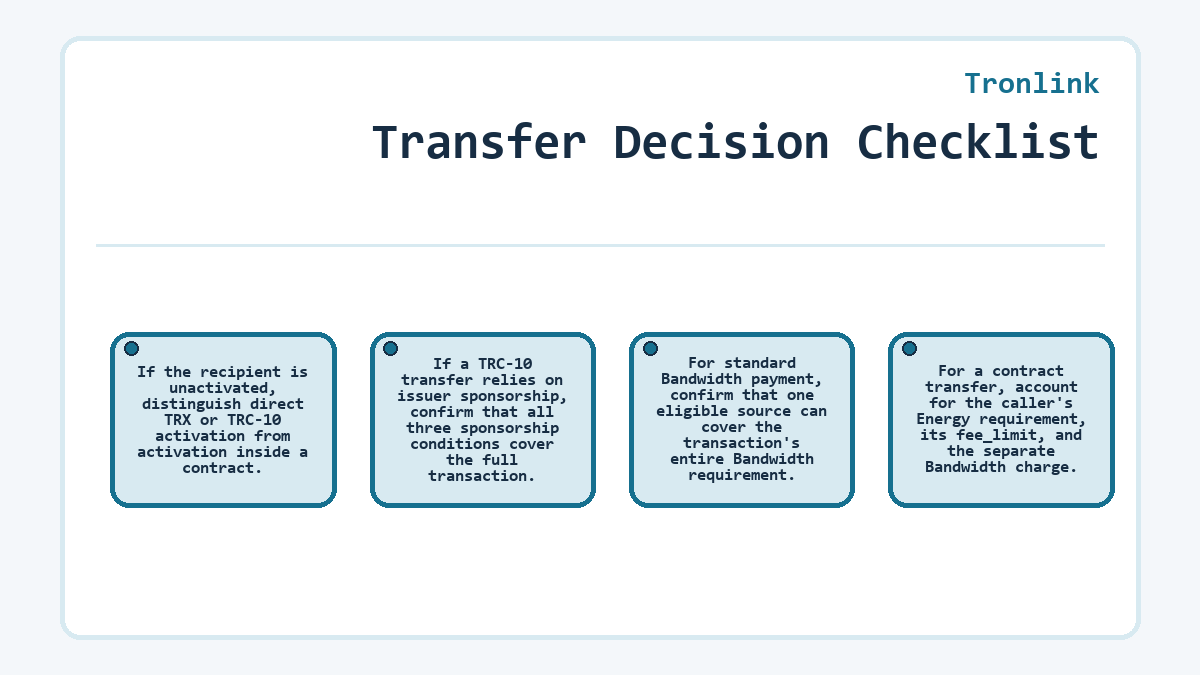
Transfer Decision Checklist
- If the recipient is unactivated, distinguish direct TRX or TRC-10 activation from activation inside a contract.
- If a TRC-10 transfer relies on issuer sponsorship, confirm that all three sponsorship conditions cover the full transaction.
- For standard Bandwidth payment, confirm that one eligible source can cover the transaction's entire Bandwidth requirement.
-
For a contract transfer, account for the caller's Energy requirement, its
fee_limit, and the separate Bandwidth charge.